JavaVCPU
JV-DOS 1.3
JV-DOS runs as guest bytecode. It provides a shell, persistent named files, an editor, JVS interpretation, COM loading and small media viewers. Commands and filenames should be uppercase. Click the VM window before typing.
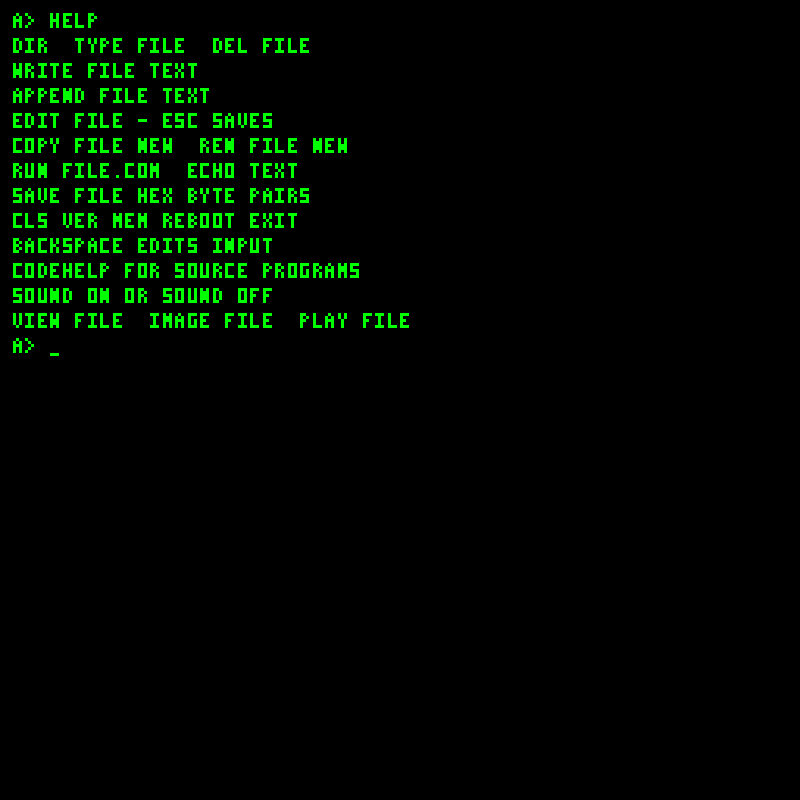
Command help (HELP) |
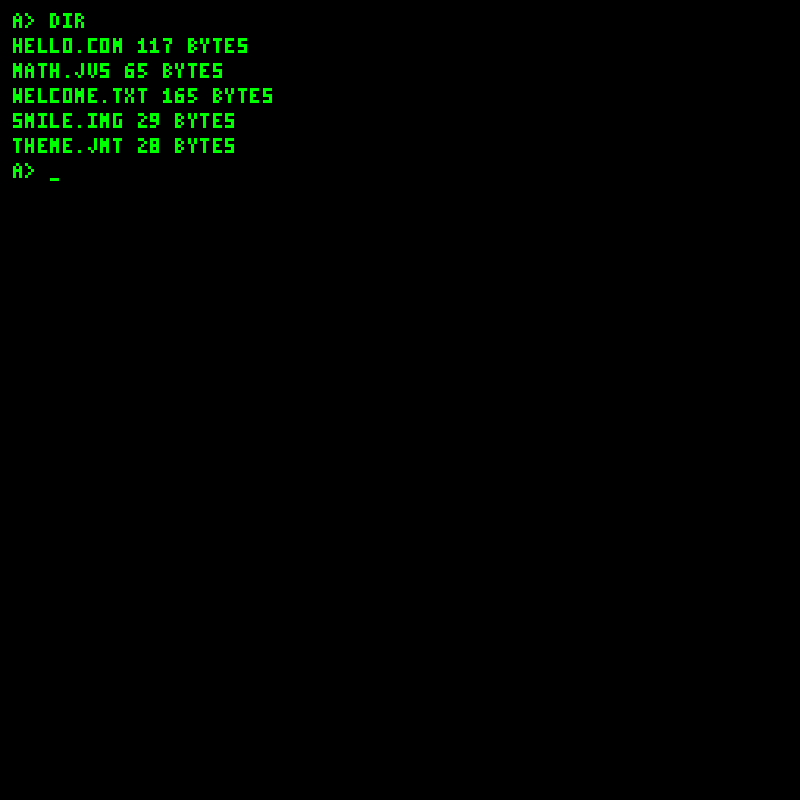
Directory (DIR) |
|---|---|
 |
 |
| Command | Purpose / example |
|---|---|
HELP, CODEHELP |
Shell or programming help |
DRIVE, DRIVE N |
Show/select a mounted storage device (0-255); resets to bank 2 root |
DIR |
List the current folder; folders show <DIR> |
MKDIR NAME, MD NAME |
Create a folder |
CD NAME, CHDIR NAME |
Enter a child folder |
CD .., CD /, CD \ |
Go to the parent or bank root |
RMDIR NAME, RD NAME |
Remove an empty child folder |
TYPE NAME, CAT NAME |
Print file contents directly |
VIEW NAME, MORE NAME |
Read a document with navigation |
WRITE NAME TEXT |
Create or replace text |
APPEND NAME TEXT |
Append text to an existing file |
EDIT NAME |
Create/open a file in the editor |
COPY OLD NEW |
Copy to a new name |
REN OLD NEW |
Rename to an unused name |
DEL NAME, ERASE NAME |
Delete a file |
SAVE NAME HEX |
Create binary content from uppercase hex byte pairs |
RUN NAME |
Interpret text, load bytecode, or open image/music by type |
IMAGE NAME, SHOW NAME |
Display a palette image |
PLAY NAME |
Play a MIDI-note stream |
PRINT TEXT, ECHO TEXT |
Print literal text |
CLS, CLEAR |
Clear display |
VER, MEM |
Version and memory/file limits |
SOUND ON, SOUND OFF |
Enable/disable keyboard clicks |
BEEP |
Short tone |
REBOOT |
Restart the resident guest boot routine |
EXIT |
Halt the CPU |
Each disk bank provides 255 shared blocks. Names have up to 12 characters. Files use one or more linked blocks and can hold up to 61,200 bytes, subject to available bank space. Folders can nest and share the bank?s block pool; each folder consumes one block. Names are unique within a folder, so different folders can contain files with the same name. File commands accept a single name in the current folder; navigate with CD instead of supplying a multi-component path. DEL and other file commands reject folders; use RMDIR after removing their contents. The CLI and source reader have a 100-character line limit; use Workshop to import longer documents or binary files. COPY/REN report DESTINATION EXISTS if the target name is taken.
Editor and viewers
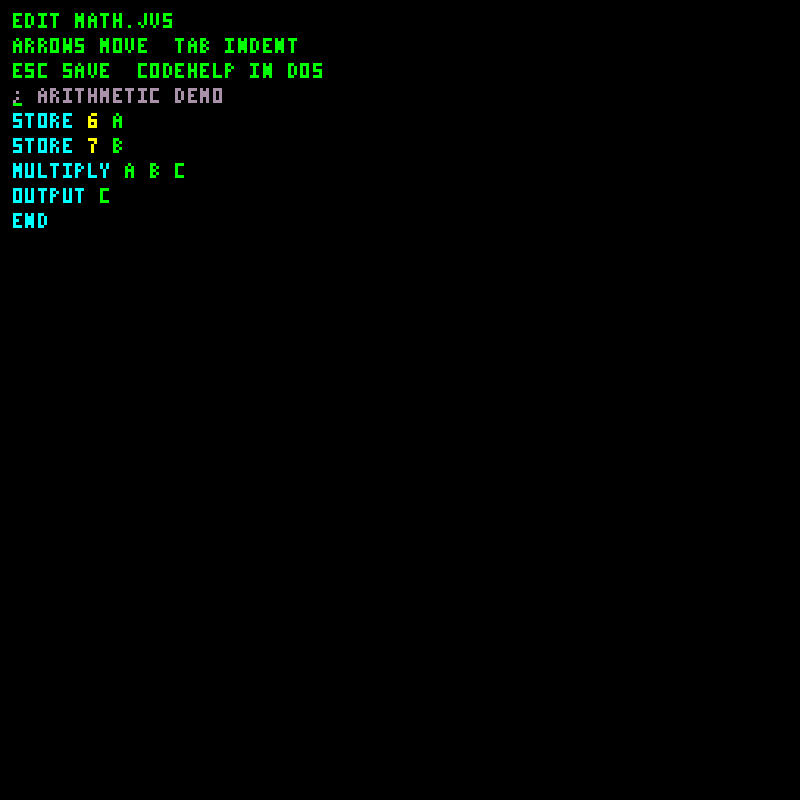
EDIT DEMO.JVS opens the guest source editor. Arrow keys move; Home/End navigate the line; Backspace and Delete remove characters; Enter inserts a newline; Tab indents. Esc saves and leaves. It is not a cancel operation. The editor highlights source text.
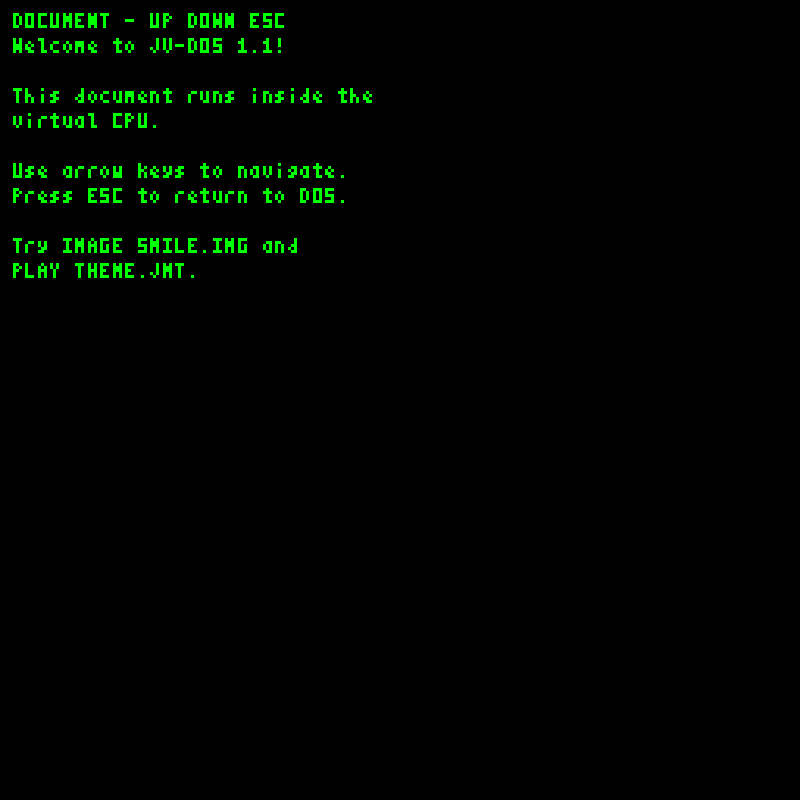
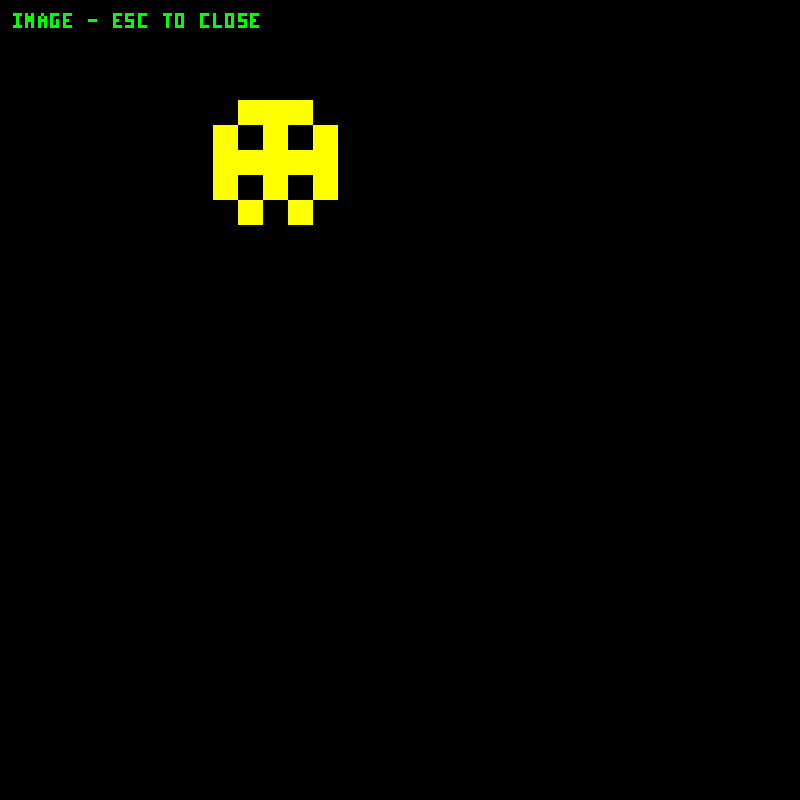
The document pager uses Up/Down, Page Up/Page Down, Space/Enter and Home; Esc closes it. Image viewing closes with Esc, Enter or Q. Esc stops music and silences its voices. A running JVS program checks for Esc between statements.
| Source editor | Document pager |
|---|---|
 |
 |
| Palette image | Music playback status |
|---|---|
 |
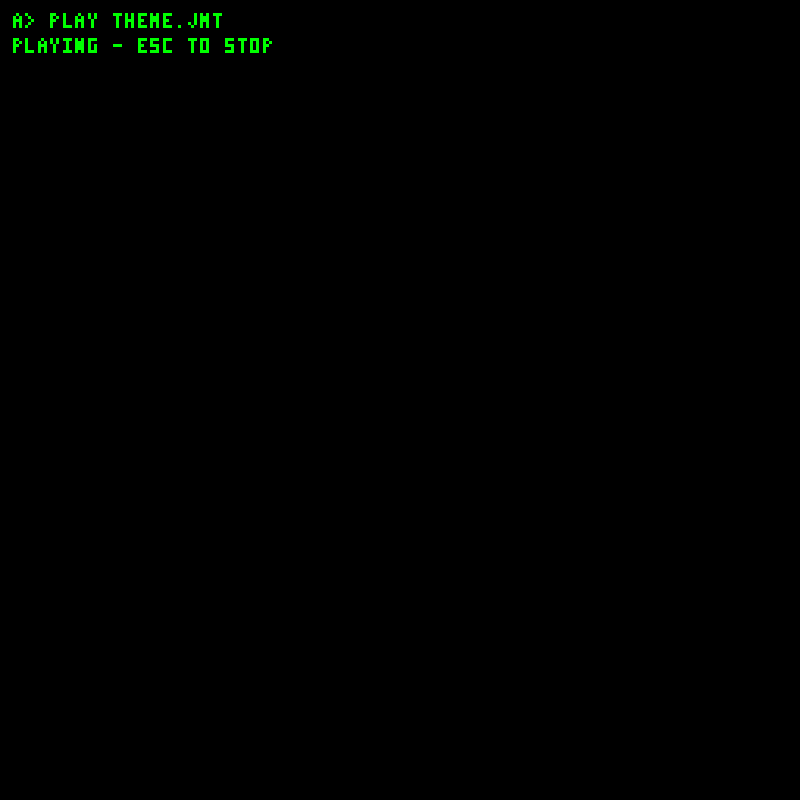 |
The screenshot gallery also shows startup, programming help and program execution.
RUN dispatches image/music from their file type, interprets type-1 text, and otherwise validates and loads raw bytecode. It also heuristically treats binary content starting with printable bytes 32-90 as source. The supplied COM starts with opcode 2 to avoid that ambiguity. Filename extensions alone do not define the execution format.
See JVS programming, COM programming, and Tooling and Disk Workshop.
Disk banks (JV-DOS 1.3)
The disk has 254 file banks, numbered 2-255, with 255 blocks shared by all files in each bank. BANK shows the selected bank. BANK + and BANK - move one bank at a time and stop at the boundaries. Reboot returns to bank 2. Existing files remain in bank 2; no disk conversion is required. All file commands use the selected bank and current folder, and COPY/REN stay within that folder. Changing banks resets the current folder to root. Reboot also resets the folder to root while preserving folders and files. Larger files consume multiple blocks; small files retain their existing layout.
The backing hard drive remains 16 MiB because the CPU uses a three-byte disk address. DOS now uses most of that space through linked file blocks. The Java DOS image assembler lives in xyz.ignite4inferneo.jvdos; CPU and device code remain in xyz.ignite4inferneo.
The editor buffers files in RAM bank 1, supports 16-bit cursor positions, and commits on Esc. When the bank is full, the existing disk file stays unchanged and the editor retains its buffer for shortening and retrying. TYPE/VIEW, COPY, APPEND, REN, DEL, JVS RUN and COM RUN support linked files.
Shell history and completion
At the DOS prompt, Up recalls older commands and Down moves toward newer commands. The last 16 submitted, nonempty interactive lines are kept until reboot. Moving Down past the newest entry restores the line you were drafting, including its cursor position. Recalled commands can be edited and submitted again. JVS statements and editor text are not added to history.
Tab completes the word at the cursor. Repeated Tab cycles matching command names, or names in the current folder of the selected disk bank for file-command arguments (including both COPY/REN filenames). The rest of the input line is preserved. A completed final word receives a trailing space. Unmatched prefixes and replacements that exceed the 100-character line limit leave the line unchanged. Typing or moving the cursor starts a new completion search. In EDIT, Up/Down still navigate the document and Tab inserts four spaces.
Reading the kernel source
src/main/java/xyz/ignite4inferneo/jvdos/JvDosImage.java describes guest instructions with named OPCode values, one emitted instruction per line. Asm.emit checks operand counts before encoding bytes. Labels and the get/put, call/ret and file-buffer helpers hide address fixups and state layout.
A-D hold working values, E/F support existing addressing sequences, and G/H implement far branches and the COM entry stubs. I/J handle indirect RAM reads without overwriting A-H. K/L hold glyph pixel coordinates, avoiding temporary RAM writes during rendering. M-P are available for future routines. Helpers can overwrite their documented scratch registers; guest JVS variables A-P live separately at bank 0, page 252, offsets 224-239.
The register parser converts letters A-P directly into variable indices. RUN clears all sixteen JVS variables. Existing COM entry points and disk file layouts are unchanged. System-image revision 13 triggers installation of the updated kernel on next startup while preserving user files.
Folder storage
The existing file headers and linked data blocks retain their layout. Directory headers use type 4, zero length and no continuation. The reserved page 255 in each file bank stores parent IDs at offsets 1-255, indexed by head slot plus one. ID 0 means root; other IDs identify a directory slot plus one. Offset 0 retains the existing initialization marker. Existing flat images have zero parent metadata and open as root files without conversion. Directory entries and file data share the 255 allocatable blocks; continuation ownership validation still covers the entire bank.
For example:
MKDIR DOCS
CD DOCS
WRITE NOTES.TXT HELLO
MKDIR DRAFTS
CD DRAFTS
WRITE NOTES.TXT DRAFT
CD ..
DIR
CD /
Additional disks are mounted with program arguments such as --disk=1=secondary.img. Each has independent banks and folders. The guest TCP network controller and sample program are described in Peripheral buses.